Receipts and coding, cleared faster
Receipt-capture and AI auto-coding handle the data entry, so a month's transactions are extracted and categorised in a fraction of the time — leaving you to review, not retype.

A Works Co. manual · No. 08
This is a desk service, and AI now does a lot of the data entry — so we will not pretend a machine can't touch it. What AI cannot do is be the named, accountable human a local builder or plumber trusts with their shoebox of receipts and their compliance. You own the relationship, the judgement and the sign-off; AI just clears the routine work so one person can run a full monthly book.
Buy any two manuals, get the third free — add 3 to your basket and use code THIRDFREE.
Instant download · PDF + Excel · 121 pages · 10 spreadsheets · 60 prompts
AI-proof by design
Bookkeeping is more AI-exposed than a hands-on trade, and software already auto-codes transactions and reads receipts. The durable moat is not the data entry — it is being the trusted, supervised, accountable human a local tradesperson hands their books to. AML supervision, the compliance sign-off, the judgement on a messy CIS return, and the local relationship that comes through referral all stay human. The honest position in 2026 is to let AI do the routine work and own the trust, the advice and the responsibility yourself — a full monthly book, kept by someone the client knows by name.
The headline feature
Every manual ships with an Excel toolkit and a 60-prompt AI library mapped to the real jobs of bookkeeping for trades — so one person can run a serious operation without staff or evenings of admin.
Receipt-capture and AI auto-coding handle the data entry, so a month's transactions are extracted and categorised in a fraction of the time — leaving you to review, not retype.
The Excel workflow and the 90-day checklist turn VAT quarters, CIS and payroll dates into a repeatable routine — no missed filings across a full book of clients.
Draft a chaser, a month-end summary, or a clear explanation of CIS or the VAT reverse charge from a prompt — in your voice, in seconds.
The prompt library drafts a priced proposal, an engagement-letter outline and a monthly management summary, ready for you to check and send.
Start before you register
You do not need an office, staff or a website to take your first client. The start cost is genuinely low — a laptop you likely own, cloud bookkeeping software, training, insurance and your AML supervision fee, roughly £300–£1,500 all in. One VAT-registered or CIS client at £150–£400 a month covers the lot in the first month, and the manual walks you from registration and AML supervision to your first paying monthly clients via accountant referrals and local trade groups.
UK-accurate, not guru noise
Software, training, insurance and AML supervision — laptop usually already owned.
You must be supervised for anti-money-laundering — via HMRC or a body (ICB/AAT/IAB) — before taking clients.
A client registers for VAT once turnover passes this; VAT and CIS clients pay the higher monthly fees.
A VAT-registered or CIS trade client, per month. Basic sole-trader books run £50–£150.
See inside
Real pages from the manual you'll download — not mock-ups.
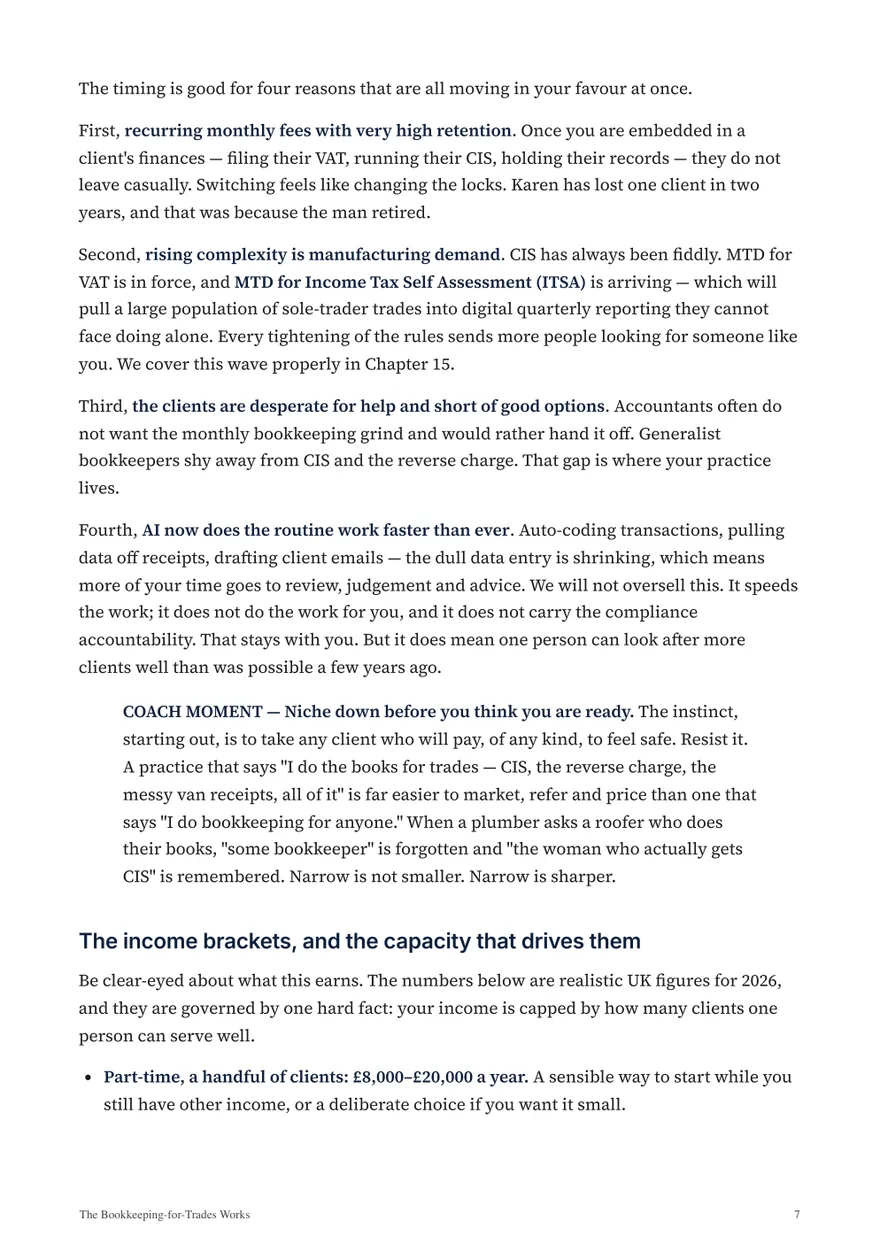
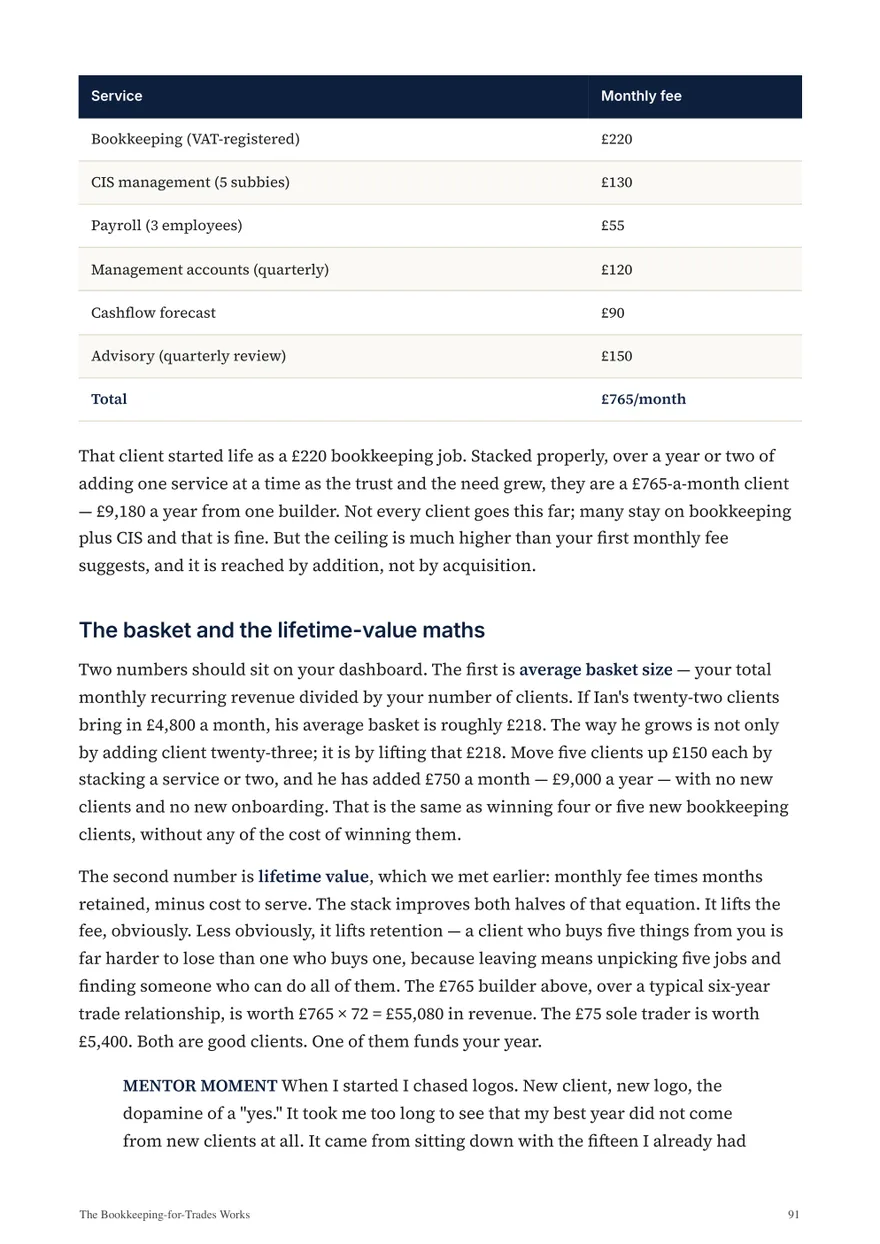
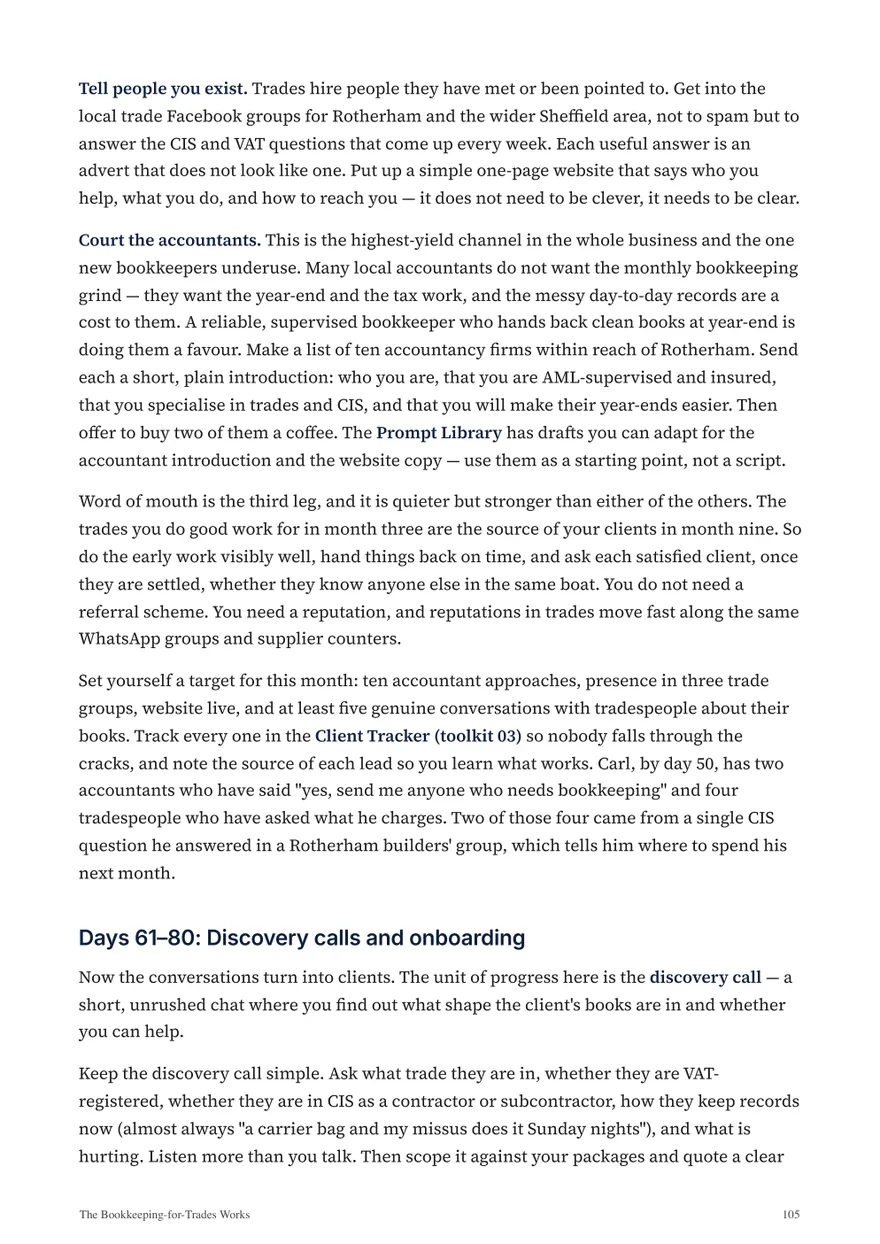
The complete first chapter, straight download — no email address needed.
What's inside
Choose where you start
Everything you need to take your first monthly client.
Build a small practice, not just a single-handed book.
No incorporation required to start. Same-day, no-questions refund.
The price, in context
Plus ongoing fees, territory rules and their brand on your van.
A webinar funnel, an upsell ladder, and a mentor you never meet.
The complete book, toolkit and prompt library. Free updates for life. Refund without friction.
No franchise contract, no territory rules, no mentor you never meet. Buy the manual, read it, and if it isn't the honest, UK-accurate, do-it-this-weekend book it promises to be, email us — we'll refund you in full and you keep the files. The only thing you're risking is the price of a book.
Honest questions
Yes. Anti-money-laundering (AML) supervision is a legal requirement for a practising bookkeeper in the UK — either directly through HMRC or through a professional body. You cannot legally take clients without it. You do not strictly need a formal qualification, but joining the ICB, AAT or IAB is strongly recommended: it gives you AML supervision, a practice licence and the credibility that wins trade clients. You should also hold professional indemnity insurance and register with the ICO.
Register with HMRC, get AML-supervised (through HMRC or a professional body such as the ICB, AAT or IAB), take out professional indemnity insurance, register with the ICO, set up an agent services account to file on clients' behalf, and choose your cloud bookkeeping software. Then niche on the trades — electricians, plumbers, builders — who need help with CIS, VAT and Making Tax Digital, and win your first clients through local trade groups and accountant referrals. The start cost is roughly £300–£1,500.
Fees are a fixed monthly amount per client: £50–£150 for basic sole-trader books, £150–£400 for a VAT-registered or CIS client, and £300–£600+ with payroll, management accounts or advisory. A part-time book earns around £8,000–£20,000 a year; a full-time solo bookkeeper with roughly 10–30 clients earns £30,000–£55,000 a year at high margin; a small practice with staff can turn over £80,000–£150,000 or more.
It is, but be clear-eyed about it. AI and software now auto-code transactions and read receipts, so pure data entry is shrinking. The value moves to what stays human: the AML-supervised, accountable bookkeeper who owns the compliance, the judgement and the local relationship. Making Tax Digital for Income Tax is also arriving and will push a wave of trade clients to need help. The honest play is to run lean with AI and be the trusted human, not to compete on typing.
Tradespeople hate paperwork, are time-poor, and have specific needs a generalist often gets wrong: the Construction Industry Scheme (CIS), the VAT domestic reverse charge for construction, cash-basis accounting, mileage and materials, and messy receipts. A bookkeeper who understands trades is worth more than a generalist, retains clients longer, and gets referred from one trade to the next.
Tools & suppliers
A short, honest list of what gets you started. Some links are partner links; we only list things a real operator uses.
Everything you need to start bookkeeping for trades — the manual, the Excel toolkit and the 60-prompt AI library — in one instant download.